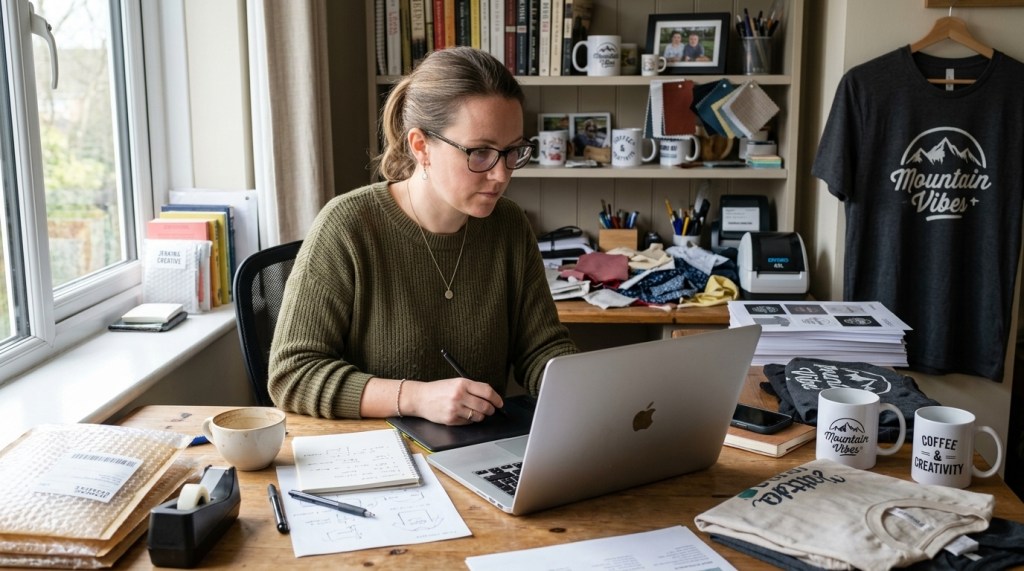
A few years ago, I went to a workshop on print-on-demand. If you’ve never looked into it, the idea is almost irresistible. You design something for a mug, T-shirt, tote bag or whatever else strikes your fancy, put it online, and when somebody buys it, another company prints it and ships it.
No inventory stacked in the house. No packing orders. No buying 500 mugs and hoping somebody eventually wants them.
I liked that part a lot.
The workshop I attended was through Rachel Rofé’s Low Hanging System. I paid for the training, went home and got busy making mugs. Lots of mugs. I think I made about 100 designs, usually ten or so in every popular category I could think of. Dogs, teachers, hobbies, whatever looked like it might sell.
After a month, I had one sale.
I had spent a fair amount of time creating those designs, and one mug sale was not exactly setting my world on fire. So I abandoned the whole thing and moved on.
Looking back, I don’t think the lesson was that print-on-demand doesn’t work. Plenty of people do make money at it.
The bigger problem was competition.
I had walked into an enormously crowded room and added another hundred mugs.
That is the funny thing about print-on-demand. One of its greatest advantages is also one of its biggest problems. It is incredibly easy to get started. Printify and Printful both still offer free plans with no monthly fee required just to begin creating and selling products.
That sounds wonderful when you are the person trying to start a business.
It is a little less wonderful when you realize everybody else can start one just as easily.
And AI has lowered the barrier even further. It can help generate sayings, product ideas, descriptions, keywords and designs in minutes. The technical part of making a mug or T-shirt is getting easier and easier.
But making something that a customer chooses out of thousands of similar products is still hard.
That was where I went wrong the first time.
I thought I was diversifying. I made a little dog stuff, a little teacher stuff, a little hobby stuff. I figured if I spread 100 products across enough categories, surely something would catch.
What I really needed to do was specialize first.
If I were starting over today, I would choose one group of people I understood unusually well and start there.
Long-haul truckers would be an obvious one for me because I have lived in that world. I know the jokes, the frustrations, the language, the strange little things truckers complain about and laugh about that somebody sitting at home typing “funny trucker sayings” into AI probably would not know.
Or maybe you know bass fishermen. Not just that fishing is popular, but the inside jokes, the ongoing arguments, the ridiculous amount of money people spend on gear and the stories they tell one another over and over.
Maybe you know owners of one particular dog breed so well that you instantly understand what makes them laugh.
That is very different from picking ten popular categories and making generic products for all of them.
Then, once I found a group I understood, I would diversify within that group.
Maybe I start with ten designs instead of 100. A mug, shirt, sticker, tote or gift. Some funny, some serious, some for birthdays or retirement. I would watch what people actually bought before I spent weeks creating more.
That way I am still diversifying, but I am diversifying around one customer instead of scattering products all over the Internet.
And that is the biggest change in the way I think about print-on-demand now.
Print-on-demand is not really the business. It is the factory.
The business is understanding who you are selling to well enough that your product gets noticed in a sea of things they could ignore.
Once you start getting sales, things get more interesting. Now customers are giving you information. If one design sells and nine don’t, maybe the one deserves several variations. Maybe the mug becomes a shirt. Maybe buyers start telling you what they wish you had.
At that point, you are no longer guessing quite so blindly.
There are some other costs worth knowing about. If you sell through Etsy, for example, there is currently a 20-cent listing fee and a 6.5% transaction fee, plus payment-processing and potentially other fees depending on how you sell.
There is also a cash-flow wrinkle that surprised me when I first learned about this model. With a service such as Printify, you are charged when the order goes into production. The customer may have paid through Etsy or another marketplace, but that does not necessarily mean the money has reached your bank yet. New Etsy sellers can sometimes wait about 14 days before funds become eligible for deposit.
That probably does not matter much if you have three orders. If you suddenly have 100, you may need enough available cash or credit to pay for production while you wait for marketplace payouts.
Still, compared with buying a garage full of merchandise and hoping you can sell it, I like a lot about print-on-demand.
You can work from home. Your schedule is flexible. Startup costs can be low. Somebody else handles the printing and shipping. And when one of your brilliant designs turns out not to be brilliant after all, you do not have 200 copies sitting in boxes staring at you.
Would I try it again?
Yes.
But I would never again begin with, “What should I put on a mug?”
I would begin with:
Who do I understand better than the average seller?
Then I would make a few things for those people, see what happens, and let actual buyers tell me whether I had earned the right to make the next 90.
Sources
Rachel Rofé, Low Hanging System
https://rachelrofe.com/low-hanging-system
 Pin Money
Leave a comment